Nicotine Withdrawal: Symptoms, Timeline, and What to Expect
For most smokers, withdrawal is the boogeyman that keeps the next cigarette lit. The fear of it — the headache, the irritability, the sleepless nights, the unbearable crawl of a craving that refuses to break — is reliably the single most cited reason that quit attempts are postponed, abbreviated, or abandoned within the first week.1 The fear is rational. Nicotine withdrawal is genuinely uncomfortable, and dismissing that discomfort with "you can do it" platitudes does not survive contact with day three.
But the discomfort itself is misnamed. Withdrawal is not the body breaking down. It is the precise sensation of a nervous system that has been forced into chemical dependence beginning to repair itself. Every symptom of withdrawal — every craving, every wave of irritability, every interrupted sleep cycle — is the direct, measurable, and time-limited consequence of receptors recalibrating, neurotransmitter systems rebalancing, and autonomic tone returning to baseline. None of it is permanent. All of it is biologically scheduled.
This article maps that schedule. Knowing exactly what is happening, why it is happening, and how long it will last converts an unpredictable nightmare into a predictable, beatable process.
⚡ The Bottom Line: If You Are In Withdrawal Right Now
If you are reading this in the middle of a craving and your attention is fractured, skip to the action items:
- Cravings peak at 3–5 minutes and fall on their own.2 Set a timer. You only need to outlast it, not defeat it.
- Use the 4-7-8 breathing pattern right now — inhale 4 seconds, hold 7, exhale 8. Three rounds is sufficient to break a craving's peak.
- The worst day is day 2 or 3, not day 1. If today feels worse than yesterday, that is on schedule, not a sign of failure.
- Acute withdrawal ends within 2–4 weeks.3 The receptor changes that drive it physically reverse — they do not require willpower to resolve.
The Neurobiology: Why Withdrawal Happens
Nicotine binds to a specific class of receptors in the brain — the nicotinic acetylcholine receptors, particularly the α4β2 subtype concentrated in the ventral tegmental area and prefrontal cortex.4 Under normal conditions these receptors respond to acetylcholine, the neurotransmitter that regulates attention, arousal, and reward signaling. Nicotine is a near-perfect mimic of acetylcholine at these sites, but it activates them with greater potency and a slower clearance, which produces the immediate dopamine release in the nucleus accumbens that smokers experience as relief, focus, or pleasure.
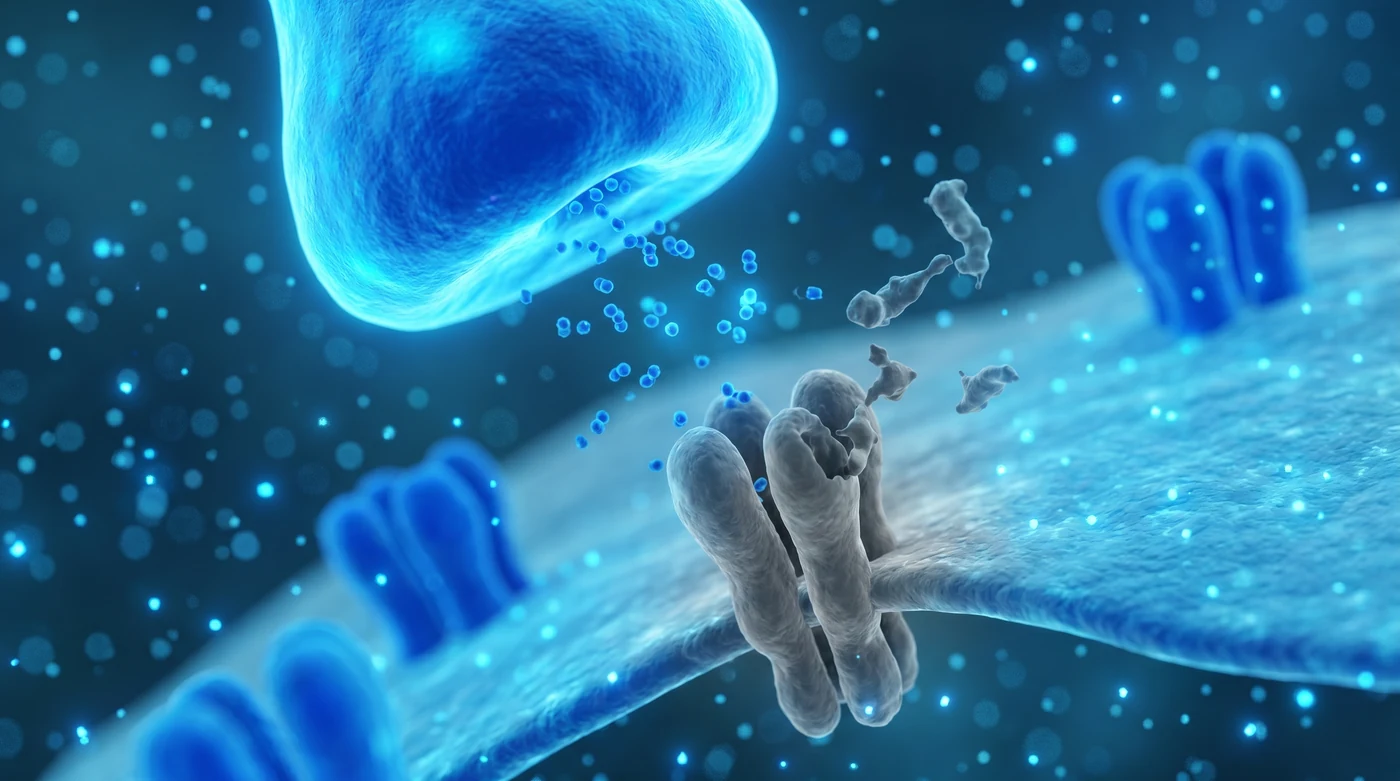
The brain adapts. With repeated exposure, two changes occur in parallel. First, the number of nicotinic receptors physically increases — a process called upregulation — to compensate for the constant overstimulation. Second, the brain's endogenous reward system, including its baseline dopamine tone, downshifts to maintain homeostasis in the presence of the chronic nicotine signal.5 Smokers do not have the brain they were born with. They have a brain that has rewired itself around the assumption that nicotine will be present.
When smoking stops, that assumption is suddenly false. The upregulated receptors are still there, but the ligand they have learned to expect is not. The mesolimbic reward pathway, which has been operating with nicotine as a co-regulator, is now in deficit. Cortisol rises. Heart rate variability drops. Sympathetic nervous system tone — the "fight or flight" axis — runs unopposed for the first time in years.5 The constellation of feelings that emerges from this state is what we call withdrawal.
The reframe that matters is this: every symptom you feel during withdrawal is the audible signal of receptors recalibrating. The discomfort is not damage. It is the measurable noise of a brain returning to a state in which nicotine is no longer required for normal function. And critically — receptor downregulation back toward baseline is not aspirational. It is biologically guaranteed in the absence of nicotine, and it begins within days.4
Withdrawal is not your body breaking down. It is the sensation of a brain that finally has permission to rebuild itself.
The Timeline: Four Phases of Healing
The withdrawal trajectory is well-characterized in the clinical literature.3,6 Symptoms do not arrive as a single undifferentiated wave; they arrive in distinct, predictable phases, each driven by a different underlying mechanism. Knowing which phase you are in tells you which symptoms are next, which are leaving, and which action to take.
Schematic of withdrawal symptom intensity. Curve shape based on Hughes (2007), Hendricks et al. (2009), Piper et al. (2011). Individual experiences vary.
Phase 1: The Crash (4–24 hours)
What's happening: Nicotine has a plasma half-life of approximately two hours.4 Within 4–6 hours of the last cigarette, blood nicotine has fallen below the threshold that the upregulated receptors require to feel "normal." Heart rate and blood pressure begin to normalize. The autonomic nervous system, which has been operating on a nicotine-modulated rhythm, is suddenly forced to find its own equilibrium.
How it feels: A creeping unease. Mental fog. The unmistakable "panic of empty pockets" — the realization that the usual reflex is gone. Most smokers describe this phase as anxious irritation rather than acute pain. The first few cravings of the quit are usually here, and they are often the easiest cravings to dismiss because the cognitive resolve is still fresh.
What to do: This is a distraction phase, not a willpower phase. Cravings in the first 24 hours are short — often under two minutes — and respond well to physical action. Walk, drink water, change rooms. Do not negotiate with the urge; simply move past it. Save your psychological reserves for what is coming.

Phase 2: The Peak (Days 2–3)
What's happening: Nicotine and its primary metabolite, cotinine, are now fully cleared from the bloodstream.4 The upregulated receptors have no agonist at all, and they fire with maximum intensity. Sympathetic tone is at its peak; parasympathetic recovery has not yet begun. This is the neurobiological worst case.
How it feels: Intense, frequent, intrusive cravings. Headaches. Acute irritability. Spikes of anxiety that arrive without an obvious trigger. Many smokers describe day 2 or day 3 as the moment they came closest to relapse — the symptoms feel categorically different from day 1, and the brain interprets this escalation as evidence that "it will only get worse."
That interpretation is wrong. Day 3 is the structural peak. Hendricks et al. (2009), in a fine-grained analysis of the first 72 hours of abstinence, documented that withdrawal severity rises through approximately 72 hours and then begins a measurable decline.6 If you are in this window, you are not at the bottom of a slope you cannot see. You are at the top of one.
What to do: This is the phase where craving science earns its keep. A craving at peak intensity is still a time-limited event — it builds, peaks within 3–5 minutes, and falls whether or not it is acted on. The clinical literature on urge surfing, mindfulness-based relapse prevention, and resonance breathing all converges on the same instruction: do not fight the craving and do not flee it. Observe it, ride it, and let it pass. The neuroscience of why this works — and the specific techniques that operationalize it — are covered in detail in The Psychology of Cravings: Why Urges Peak and Pass.
Phase 3: The Dopamine Dip (Weeks 1–2)
What's happening: Acute physical withdrawal is now resolving. Nicotinic receptor density is beginning to fall back toward baseline.4 But the dopamine system that smokers spent years co-regulating with nicotine is slow to restore its own tone. The result is a period in which the brain is no longer screaming for nicotine, but its own reward-generating machinery has not yet come fully back online.
How it feels: Lethargy. Flat mood. Mild depressive symptoms. Insomnia or non-restorative sleep. A sense that nothing — food, conversation, work, exercise — is quite as rewarding as it should be. This is the cluster colloquially called "quitter's flu," and it is the phase where many smokers, having survived the acute peak, quit the quit — convinced that life will simply be grayer without nicotine.
It will not be. The dopamine dip is, again, time-limited. Hughes (2007), reviewing the abstinence symptom literature, found that mood-related symptoms typically resolve within 2–4 weeks for the large majority of quitters.3
What to do: Phase 3 responds to inputs that elevate endogenous dopamine. Aerobic exercise, cold-water exposure, completing small concrete tasks (the "task completion" dopamine pulse is real), social contact, and regular sleep timing all measurably help. This is also the phase where it is most useful to log progress — checking off a clean day produces the same micro-reward circuit activation that nicotine used to occupy.
Phase 4: The Extinction Burst (Weeks 3–4 and beyond)
What's happening: The receptor population is largely back to baseline. The acute neurochemistry of withdrawal is essentially resolved. What remains is the learned component — the conditioned associations between specific contexts (the morning coffee, the post-meal pause, the work break, the second drink) and the act of smoking. These associations are stored separately from the receptor system and they do not extinguish on a chemical schedule; they extinguish on a behavioral one.
How it feels: Sudden, isolated, often surprising cravings. They arrive in week three or week four out of nowhere — frequently in response to a context the smoker did not realize was a trigger. Piper et al. (2011), tracking smokers through extended cessation, documented that craving frequency declines steadily after the acute window but that discrete craving events can reappear well after physical withdrawal has resolved.7 This is sometimes called the "extinction burst" — a final, episodic flare-up of conditioned cue reactivity before the association weakens permanently.
These late cravings are clinically important because they are the ones that catch quitters off-guard. The acute window is expected to be hard; week four is expected to be easy, and the unexpected craving therefore carries disproportionate psychological weight.
What to do: Identify the trigger. The single most useful response to a phase 4 craving is to write down — in the moment — what context produced it. Was it a place, a time, an emotion, a person? CBT-style trigger logging is what converts an extinction burst from a near-relapse into a data point. The categories and the 4D rule covered in Mastering Triggers: The 4D Rule of Cessation are the relevant frameworks here.
The Five Symptoms Most Likely to Surface — And What to Do
Most quitters experience a subset of the same five symptoms. Each has a specific underlying mechanism and a specific response. Their intensity is not uniform across the timeline — some peak early, some peak late — and knowing which to expect when prevents the "is this normal?" panic that drives unnecessary relapses.
Crash
4–24h
Peak
Days 2–3
Dip
Wk 1–2
Burst
Wk 3–4
1. Anxiety and restlessness. Driven by sympathetic dominance during the acute window. The intervention with the strongest direct evidence is paced diaphragmatic breathing — particularly resonance-frequency breathing at six cycles per minute, which directly engages the vagal pathway and pulls autonomic tone back toward parasympathetic balance.8 The mechanism, the trials, and the techniques are covered in Breathing Exercises for Smoking Cessation: What Research Says.

2. Insomnia. Nicotine is a stimulant; its absence often produces a brief rebound period in which sleep onset is delayed and sleep is shallower than usual. This is one of the shortest-lasting symptoms and typically resolves within one to two weeks.3 The standard sleep-hygiene set — fixed wake time, caffeine cutoff by early afternoon, no screens in the final 30 minutes before bed, dark and cool sleep environment — is sufficient for the majority of cases. Do not start sleep medication for transient quit-related insomnia; it is a self-limiting symptom.
3. Increased appetite. Two distinct mechanisms collide here. First, nicotine is a genuine appetite suppressant, and its removal restores normal hunger signaling. Second, oral and habitual cues — the hand-to-mouth reflex, the activity slot that smoking used to occupy — are now seeking a substitute. The first is real hunger and should be eaten. The second is not, and is best met with hydration, sugar-free gum, or a low-calorie crunchy alternative. Learning to distinguish the two within the first month prevents the modest weight gain that some quitters experience from becoming a long-term pattern.
4. Brain fog and concentration difficulty. The acetylcholine system, which nicotine has been co-regulating, controls focus and cognitive arousal. While it recalibrates, attention can feel noticeably impaired. This is one of the more demoralizing symptoms because it interferes with work — but it is also one of the most reliably time-limited. The cognitive deficits associated with nicotine abstinence typically resolve within two to four weeks.3 Light exercise, hydration, and protein-forward meals modestly accelerate recovery; pushing through hard cognitive work during the worst of it is unnecessary and counterproductive.
5. Cravings. The signature symptom and the one most likely to drive relapse. Cravings are the intersection of all the systems above — the dopamine deficit, the autonomic spike, the conditioned cue. The single most important fact about a craving is that it is a time-limited event lasting 3–5 minutes at peak.2 The clinical interventions with the strongest evidence are urge surfing, the 4D rule (Delay, Deep Breathe, Drink water, Do something else), and paced breathing — covered in detail in The Psychology of Cravings and Mastering Triggers.
When to See a Clinician
Most nicotine withdrawal is uncomfortable but medically self-limiting and does not require professional treatment. There are exceptions worth naming. Withdrawal-related depressive symptoms that persist beyond four weeks, that involve loss of function or thoughts of self-harm, or that reactivate a prior major depressive episode warrant a clinical consultation. Cardiovascular symptoms that worsen rather than improve in the days after quitting — chest pain, severe palpitations — should be evaluated, particularly in smokers with pre-existing cardiac risk factors. And any quitter using nicotine replacement therapy, varenicline, or bupropion who experiences unexpected mood, sleep, or behavioral changes should review the medication with their prescriber rather than self-adjusting. This article is educational and does not substitute for individualized medical advice.
The Honest Closing
Withdrawal is uncomfortable. It is not, however, dangerous, indefinite, or unmanaged. The acute window is approximately 72 hours of intensity followed by 2–4 weeks of declining symptoms. The receptor changes that drive it are not permanent — they reverse on their own schedule, in the absence of nicotine, regardless of how strong your willpower is on any given day. Your job during withdrawal is not to win a war against your nervous system. It is to get out of its way while it heals.
Withdrawal is temporary. Your freedom is permanent. Use the time well.
References
- Hughes JR, Keely J, Naud S. Shape of the relapse curve and long-term abstinence among untreated smokers. Addiction. 2004;99(1):29–38.
- Sayette MA, Loewenstein G, Griffin KM, Black JJ. Exploring the cold-to-hot empathy gap in smokers. Psychol Sci. 2008;19(9):926–932.
- Hughes JR. Effects of abstinence from tobacco: valid symptoms and time course. Nicotine Tob Res. 2007;9(3):315–327.
- Benowitz NL. Nicotine addiction. N Engl J Med. 2010;362(24):2295–2303.
- De Biasi M, Dani JA. Reward, addiction, withdrawal to nicotine. Annu Rev Neurosci. 2011;34:105–130.
- Hendricks PS, Ditre JW, Drobes DJ, Brandon TH. The early time course of smoking withdrawal effects. Psychopharmacology (Berl). 2009;202(4):663–672.
- Piper ME, Schlam TR, Cook JW, et al. Tobacco withdrawal components and their relations with cessation success. Psychopharmacology (Berl). 2011;216(4):569–578.
- Lehrer PM, Gevirtz R. Heart rate variability biofeedback: how and why does it work? Front Psychol. 2014;5:756.
Technique mentioned in this article
QuitBook Mobile App
Track your progress, manage urges, and calculate your wealth saved.
Get it on Google PlayRead Next
The Health Benefits of Quitting Smoking: A Week-by-Week Recovery Timeline
From 20 minutes to 15 years: a clinically grounded, milestone-by-milestone map of what happens to your body when you quit smoking — and why the hardest week delivers the biggest gains.
Breathing Exercises for Smoking Cessation: What Research Says
Can breathing exercises reduce nicotine cravings? Discover the science of paced, diaphragmatic, and box breathing for smoking cessation. Expert guide ★ Quitbook